The Hanged Man
The Most Baffling Tarot Card of All
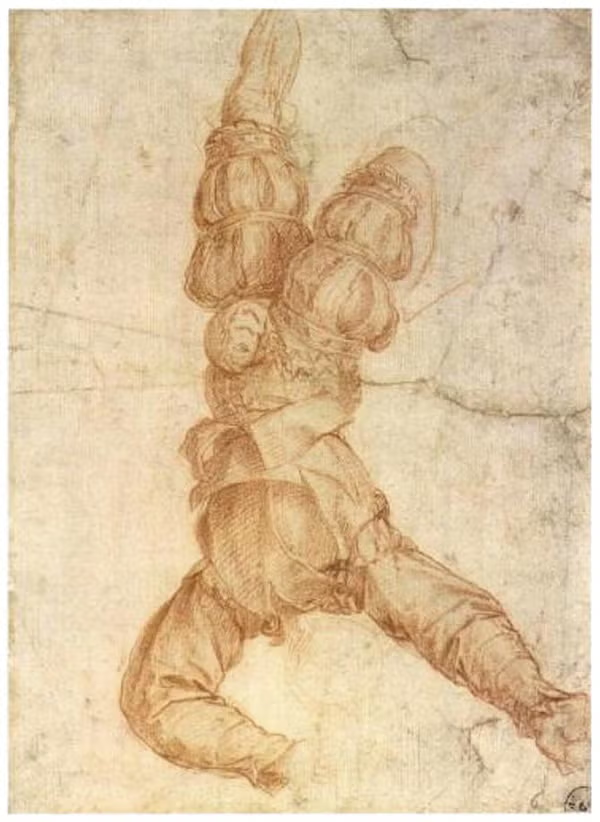
The Hanged Man confuses card readers and challenges deck creators more than any other archetype. Over five hundred years, its meaning has swung wildly—from an overt depiction of public treason to a gentle symbol of spiritual surrender. But when modern interpretations try to overwrite an image’s origins, they run into a psychological wall. By examining the interplay between visual history and the collective unconscious, we can untie this tangle—and offer a cautionary note to any card enthusiast or would-be designer on the limits of poetic license.
The visual description and contextual meaning of The Hanged Man have their roots in the social milieu of fifteenth-century Milan. Following the prevailing elite custom, the Visconti-Sforza card deck was an elegant masterpiece created for the Visconti and Sforza families. As an allegory of Renaissance philosophy, the cards educated the court on the social order via games, never divination. And for The Hanged Man card, the lesson pertained to the betrayal of trust.
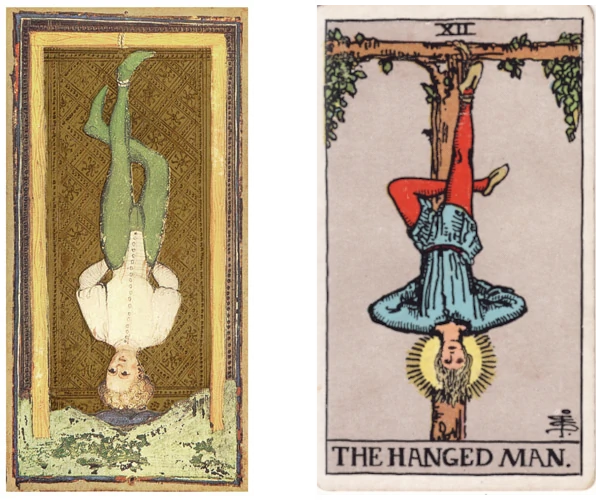
On that card, a young man is suspended upside down by one ankle from a wooden beam. His free leg is slightly bent, and his arms are tied behind his back. Unlike the current-day Rider-Waite-Smith Hanged Man card, he does not have a glowing halo of spiritual illumination around his head. Instead, he wears fine Renaissance court attire, representing the harsh legal consequence of treason.
Originally titled The Traitor, The Hanged Man is an example of a pittura infamante—a painting of infamy. These shame paintings, commissioned by civic authorities in cities like Florence, were intended to humiliate traitors, political enemies, and fugitive criminals in effigy. Figures could be shown wearing a mock paper mitre or surrounded by unclean or evil animals like pigs, donkeys, or snakes; or, they could be accompanied by explicit captions or verses detailing the person’s financial crimes, treason, or political misdeeds. To ensure lifelike resemblances, authorities commissioned notable Renaissance artists—such as Sandro Botticelli, Andrea del Sarto, and Leonardo da Vinci—to paint the frescoes on the exterior walls of palaces, administrative buildings, and prisons for public viewing.
Just as shifting power structures led to the destruction of the frescoes, the evolution of tarot decks eliminated the meaning of The Traitor. When French card makers produced the Tarot of Marseilles in the mid-1500s, they left behind the Italian cultural context of the card and retitled it based on its appearance as The Hanged Man; however, they retained its associations to treason, crime, and physical restraint. In 1781, when French occultist Antoine Court de Gébelin popularized his ancient Egyptian theory, cards became tools for divination. Unfamiliar with Italian history, he argued that The Hanged Man was printed upside down and reframed the meaning to prudence. In the early 1900s, members of the Golden Dawn added a halo to the upside-down figure and ascribed the meaning of self-sacrifice, suspension, and chosen stillness to the card, removing all connection to treason.
Although treason disappeared from the interpretation of The Hanged Man, does an unconscious residue of the card’s history still influence our minds? From the years of the pittura infamante until the 1970s—a span of about five hundred years—this card carried forward some version of a hanged man. In the 1970s, a reimagined version titled The Hanged One arrived with the Motherpeace deck. It attempted to dismantle what its creators saw as patriarchal, punitive, and violent imagery. That card described a woman in a state of voluntary spiritual initiation, surrendering to compassion and feminine receptivity. Regardless of intention, the card still showed a picture of a person hanging. It was not until recent years that the image of a hanged figure disappeared from a number of new decks—the most famous of them being Osho Zen Tarot.
For decks that remain rooted in a traditional structure, however, we still need The Hanged Man card—one with a graspable meaning. Although in today’s society, frescoes have been replaced by the FBI’s Most Wanted List, smear campaigns still show up on television and characterize politics. And on the personal level, who among us has not been betrayed or betrayed another? Who has not, at some time, suffered a drop in reputation or loss of status? Spiritualizing The Hanged Man painted a veneer over its original meaning—perhaps this is what causes confusion with the card’s interpretation.
We cannot simply paste a new, pleasant meaning over an ancient archetype and expect the psyche to forget its roots, according to the Jungian perspective. The subconscious mind registers the entire lineage of the symbol simultaneously because of archetypal residue, which exists in the collective unconscious. As part of our psychology and biology, the collective unconscious contains universal structures, instincts, and ideas inherited from our ancestors and is identical in all humans across cultures, eras, and geographic locations. It contains not images, but archetypes—instinctual, inherited predispositions to perceive, react, and experience the world in universal patterns. For example, all over the world we find the archetypal residue—a blueprint—of a Mother, a Hero, or a Wise Old Man.
By using the cards, we access deep knowledge. Jung posited a unified reality in which psyche and matter are interconnected—synchronicity is a manifestation of it. He claimed that inner psychological states and outer events interact because activation of archetypal patterns in the collective unconscious often coincides with synchronistic events. As a result, both the collective unconscious and synchronicity operate outside the conventional laws of cause and effect and beyond conventional notions of space and time.
When we engage in cartomancy, we seek transcendent knowledge. Because of the underlying unity of psyche and matter, synchronicity maps image to circumstance, allowing us to access that knowledge. When we pull a card showing a bound figure suspended upside down, the nervous system registers restraint and punishment before the conscious mind registers anything else. Since our interaction with these symbols occurs on that archetypal level, when we draw The Hanged Man, it should resonate with awe—why betray it with an incongruous interpretation?