Ivan Bilibin, courtesy of Wikimedia Commons / Public Domain
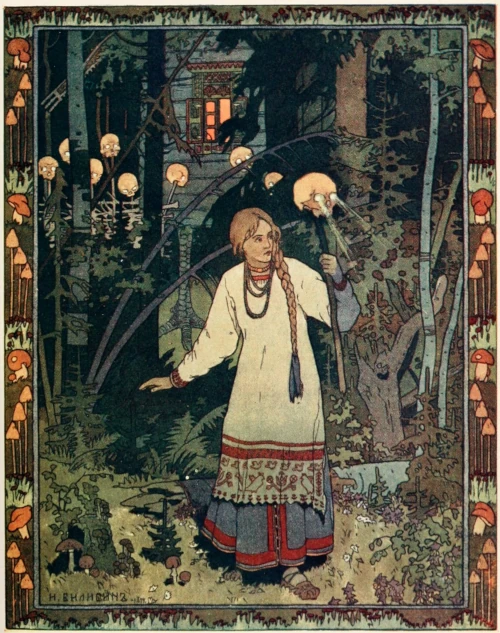
A fairytale about a young girl called Vasalisa depicts how it feels to follow inner knowing. It unfolds like this: Vasalisa’s mother dies, and as she’s dying, gives Vasalisa a doll, telling Vasalisa that if she needs help or loses her way, the doll will guide her. Eventually, her father remarries, leaving her in the company of her new stepfamily, who treat her cruelly. But her father doesn’t notice, and because of his indifference, Vasalisa is left alone to manage the difficult chores created by them. She secretly consults the doll her mother gave to her, listening and paying attention to its signals about how to manage the daunting work. Because she overcomes the hard tasks so successfully, they conspire to let the house fire die so that they can send Vasalisa through the dark forest to visit the terrifying Baba Yaga for a coal to relight the fire.
Ivan Bilibin, courtesy of Wikimedia Commons / Public Domain
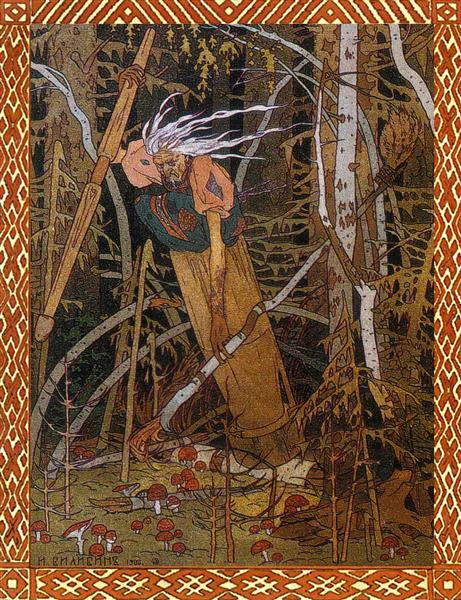
When Vasalisa finds Baba Yaga, Baba Yaga commands Vasalisa to undertake many insurmountable tasks. Vasalisa, again, secretly consults her doll and completes all the tasks. Finally, Baba Yaga has no choice but to acknowledge Vasalisa’s accomplishments, and although begrudging her success, she notices Vasalisa’s wisdom and gives her a skull with fiery eyes that is attached to a club. Having attained that fire, Vasalisa finds a chance to escape.
As she runs home through the dark forest, the weight of the club exhausts her and the eerie light of the skull frightens her. But as she considers throwing it away, the skull speaks, urging her to stay calm and continue home. She arrives triumphant, having survived the dangerous journey. By the next morning, her stepfamily is burned to ashes by the fiery gaze of the skull, which had observed their every move.
Not everyone has heard this story of Vasalisa because it’s a Russian fairytale transcribed in the mid-1800s from the oral storytelling tradition. And although it may hint of Cinderella, its themes are much heavier. Its meaning, however, pertains to the human condition as much now as it ever did. And we can find themes similar to the tale of Vasalisa through cinema.
One such theme is that of a character diagnosed with a terminal illness. The prognosis causes deep anguish, forces a reckoning with life, and commands the character to do what they must to put their life in order.
For example, the character, Rory, in the movie called The Etruscan Smile receives a cancer diagnosis, which prompts him to visit his son, Ian, who lives in the US. Like Vasalisa’s stepsisters forcing her to visit Baba Yaga, Rory’s diagnosis pushes him into a dark and scary reckoning with illness and death. Like Vasalisa’s encounter with Baba Yaga, Rory’s confrontation with his approaching death requires him to honor and follow his deep knowing. And like the mounting of difficult tasks upon Vasalisa, Rory’s conflicts build.
Conflict starts with Rory’s son, Ian, who now lives in a sleek, modern apartment far away from his childhood home in Scotland, where Rory still swims naked in the waters along the shore of the Isle of Lewis. Further, Rory objects to how Ian and his wife's intellectualized parenting of his grandson causes the baby to cry, asking “Why not take care of the child the way it’s always been done?”
But it’s Ian’s father-in-law, Frank, who greatly incites Rory’s ire. As a wealthy businessman, accomplished and hard-working, Frank epitomizes the American dream. He has also fostered Ian’s dream by giving him the opportunity to be the chef of his own restaurant. But Frank’s wealth and country club scene grate against Rory’s “say it like it is” approach. Eventually, Frank tells Rory that he prefers dignity and grace over Rory’s raw, unfiltered attitude. In response, Rory accuses Frank of not even living his life.
Like Vasalisa carrying the glowing skull through the dark, Rory’s diagnosis forces him to continue on despite life’s difficulties. And his presence, in turn, acts like that magical skull club forcing everyone around him to also carry on through life’s difficult aspects.
When Rory learns that his arch enemy has died back in Scotland, he takes to his bed. Perhaps he is reminded of the approach of his own demise, and it further weakens him. But he must also account for his attachments, for underneath the myriad likes and dislikes of his lifetime, like the rest of us, he must come to terms with who he really is when those attachments no longer exist. He rests in order to digest and process these gently.
Rory picks up once again and pushes onward. Along with having become involved in a relationship, he has become known to the linguistics department of the local university, where they invite him to record his stories in Gaelic. When his stories run out, he admits to the professor that he made stuff up. The professor smiles and says, “We know,” handing him a CD of the recorded stories. The content of the stories doesn’t matter as much as the notion that they function like Vasalisa’s doll—a legacy of memory and symbol of the intuition that Rory has passed to Ian.
The tales of Vasalisa and Rory become a legacy for humankind. They fill a gap in society, a gap which long ago and far away, could be filled with two words. These ancient words, saṁvega and pasāda, live on in the Buddhist community.
Saṁvega, according to American Buddhist monk Thanissaro Bhikkhu, holds at least three areas of feelings at once: “the oppressive sense of shock, dismay, and alienation that comes with realizing the futility and meaninglessness of life as it’s normally lived; a chastening sense of our own complacency and foolishness in having let ourselves live so blindly; and an anxious sense of urgency in trying to find a way out of the meaningless cycle.” No single English word seems to cover all three.
Pasāda is the counterpart for saṁvega. It’s the guide or inner knowing that demands we push on. It describes a complex set of feelings usually translated as “clarity and serene confidence.” They keep saṁvega from turning into despair.
These “missing” words can reveal a lot about a society. But just because a society lacks a certain word isn’t to say that its people don’t experience its meaning. As seen in the stories of Vasalisa and Rory, tales and cinema fill those gaps. The problem is that not having a word, accessible phrase, or well-known tale reduces our chances of finding others with a shared experience. We may be misled to feel isolated and lonely as if we are the only ones feeling this nameless something. We may even come to believe something’s wrong with us.
Could we benefit by bringing those words to western society? According to Thanissaro Bhikkhu, yes. He thinks that the contribution of these two words might be the strongest benefit that Buddhism could bring. In his words, “[saṁvega and pasāda] don’t exist in English, yet they describe the very threshold of human awakening. The Buddha advised his followers to cultivate both daily—not to abandon the world, but to live in it with clarity. The ability to hold both the sobering shock of existence and serene confidence in our path may be one of the most vital gifts this ancient tradition offers our culture today.”
Vasalisa and Rory both exhibit a lived experience of saṁvega and pasāda, but with different results. Whereas Rory’s crises arise from the coercion of a fateful illness,
Vasalisa’s crises result from learning to deeply listen to her own voice so that she can follow her true path. And although Rory is triumphant in settling his family matters, he does not triumph as Vasalisa does. His life ends while Vasalisa’s continues on with a greater sense of self-attunement.
The saṁvega and pasāda that Rory and Vasalisa portray are emotions cultivated on a daily basis in the Buddha’s teachings. Although they may entertain, they require hard work and are certainly not the blissful states that attract some people to meditation. They partly explain why the path of meditation can feel like a tough slog where all that seems to matter is that we showed up.
An oft-quoted story from Buddhism about the mustard seed emphasizes that we are not alone in having to face painful situations. But in everyday life, the parable of the mustard seed sounds like a social media survey—yes, we understand that we’re not special, or alone, in feeling alone. Here, the stories of Vasalisa and Rory do a more nuanced job of portraying aloneness than the mustard seed story. They show two characters attuned to their unique paths while in the company of others—alienating and lonely, at the least. What they show us is that no matter how individual or alone our paths are, we do not stop “becoming.” They show us life’s impermanence and our fragilities, leading us to consider how we will live with intention and take change in stride. And, finally, they show us that by willingly embarking on that difficult path, we may experience victory.
For Further Reading & Reference
If you’d like to explore the stories and ideas in this piece:
The Tale of Vasalisa the Beautiful: Collected in Women Who Run with the Wolves by Clarissa Pinkola Estés.
The Etruscan Smile (2018): Directed by Oded Binnun and Mihal Brezis, starring Brian Cox as Rory.
Saṁvega & pasāda: Explored by Thanissaro Bhikkhu in his essay “Affirming the Truths of the Heart” (available on Access to Insight).
This site uses cookies to enable functionality:
Cookies are used in the meditation guide to personalize the experience. These are essential for site function. Tracking cookies are used for traffic analysis and can be disabled by using the Google Analytics Opt-out Add-on.